Tuesday, 22 January 2019

                     RIVER--------- A LIFE LINE FOR HUMAN CIVILIZATION


The existence of life mostly depends on the natural resources like water , air and food. If one out of these  diminishes then it becomes a threatening object for the survival of human existence. Though this is very known fact that all ancient civilization grew faster at the bank of river .But the life pattern changes according to the situation of the environment. The growth of human civilization in all spheres occurs due to the inquisitive necessity for human society.  The trial to fulfill the necessity compel to discover so many modern method to easy the life style. unknowingly it effects our environment so badly now that its difficult to live life normally. In this way , we experience how global warming gradually effect our environment and it directly put pressure on the untimely climate change . But , the main subject for concerning is to think about the condition of river.
The flow of water at the river bed is gradually receding due to climate change . I personally have experience about the condition of river Ganga . One of my personal tour to Haridwar had seen the speed flow of water  and its deepness at the year 1995. Never think one day river Ganga will became face the scarcity of water. The environmentalist are warning so many times in different awareness programme and in many conferences that the life saver river Ganga will one day a fatal for the people of India . My recent visit again on 2018 to Haridwar and different tourist locations near River Ganga gave me enough chance to realize the threatening matter for the river.

I did not see the same flow of speed of water in Ganga river.At  some point i realized that there must be so many reasons that is effecting the river which are the life line for the people of India.While moving towards the upper most northern part of India land sliding at the hilly areas are the regular norms for everyday. It is not only effecting to the ecology  system but also it disturb the regular life of normal human society.Each and every tourist locations at Uttarakhanda, WORK AT PROGRESS ,DRIVE SLOW...these banner we crossed in every check post. Lobourers were through out day were busy to blast the hills for widening the roads. Numbers of tress at the hill areas are falling down due to this work.
The recent reviews from scientists has come out regarding the climate change hits the glaciers at Himalaya. 76% glaciers of Himalayas have shown loss in area of ice cover.The retreat will impact the water level in the Ganga.
The recent reviews from scientists has come out about the status of glaciers and how in future effect to the Himalayan river.Chaturanga glacier , a tributary of the gangotri glacier is retreating at a considerable rate and may vanish in future.the retreating glacier is another example of the impact of climate change and it will effects water flow in the Ganga , fed by the Gangotri.
Numerous efforts from government policies for saving the river may not help us to protect the condition of river.Its the responsibility of each and every individual to take steps in various method to protect our environment . The greediness of  accumulating so many materials in one time compels us to destroy the natural resources from our earth. So, be aware . At least as a civilized human being we should make effort for saving this Earth by planting numerous samplings at open and hill areas. At least it can save our climate and the life saving glaciers may not recede in future. Try not to throw any waste materials at the rivers . Create awareness among the community who are living near the river bank not to pour any industrial wastage at the river. Its not the duty of the government to look after the healthy condition of river but each one of us should take pledge to save the river. so that our so called modern civilization will exist beautifully for longer.


Friday, 4 January 2019


                                          NEELAKANTHA  -------A VICTORY OVER KAL

Time is very strange matter  to realize its importance. Every action as if revolves around it. The answer always hide in mystery . If we try to get its result then its not possible. Because, incidents happen repeatedly as per its own way. Yes, no body has any power to control over time.  An unknown force compelled me to visit Kalinjer Fort just 105 km from Khajuraho. A fort of mesmerizing beauty and keep a history of many dynasties within the wall of the fort. The famous 7 entrance gate  towards the fort creates a sensation to know more about the history.Though  Kalinjer Fort is  situated at Vindhyanchal Mountain but the heritage monuments and a list of temples gives a glimpses of our rich cultural value and architectural importance.
Neelkanth Temple which is situated in the premises of Kalinjer Fort, is a must visit place for those who are ardent lover of epic and to know more about the history of existing sculpture.once reached at the destination the crippling silence of the area imposed to think more about the time. After crossing too many stairs one would reach at the entrance of the temple.
 Not too many devotees were there at the moment of any general day. The numbers of crowd increased only at Amabasya and Shivratri festival.Once the prominent temple of Kalinjer fort is now  in a devastating stage.  As if the whole surrounding is trying to portray the debacle of time. But, Neelkanth stood as a miracle for all human being .It is believed that The Supreme Lord SHIVA took the poison and hold it at His throat to save all creatures. Soon after that His Throat changed into blue colour and named as NEELKANTH. He meditated here at this place to get rid of that pain. Water spring has been falling spontaneously on the Shiva linga since the time memorial  till now. The victory of controlling of time came to His authority.Kal Bhirav is also there on the wall of outer side of temple. Different Statues of God and the presence of beautiful architecture style of temple shows the intensity of Shaiva culture at the period of ancient time.

The present one story of temple gave a clear pictures of its beauty . Once the 7 storied temple attracted the attention of foreign invaders to grab its wealth and it was too difficult to won at the battle field.The foundation stone of Fort had laid by the famous ruler of Chandels Raja Chandra Verma but so many ancient epics and puranas mentioned the importance of Neelkanth Temple in their sciptures.


It was a great experience to visit such a wonderful place of India and got chance to interact with the loacal priests of that temple who gave us interesting tales regarding the temple . Though not ready to leave that place immediately but Time of sunset gave us indication to leave carefully as the monkey menace was also there .


Sunday, 17 June 2018

HIRAPUR-- FAMOUS FOR CHAUSANTH YOGINI TEMPLE

Curiosity increased by searching a fascinating place to visit on a hot humid day in the month of May. As per our prior planning, we landed at Bhubaneswar on the morning of 23rd May 2018 from Puri. It was compulsion inside our mind to use the time in a proper way not to waste more. Our destination was Hirapur, a small village which is situated 20km  south-east of Bhubaneswar. Though I heard a little about  Hirapur and its significance, we moved through Tankapani road and slowly entered into a narrow road, from where the sight of the village scene attracted our interest in enjoying more. A quite silent place with greenery all around with big mango, coconut trees. Mahamaya pond is the center of attraction for visitors like us. Once reached there the beauty of the place made us speechless for a moment. The serenity of the place is mesmerizing to each and every one. Luckily, no other devotees or visitors were visible except us. Once entered inside the temple the priest came to near us and chatted for few minutes and spoke about the temples past history. 


 Odisha is a land of so many temples with great architectural style. Hirapur is famous for its Yogini Temple which is one of the best self-preserved temples of the yogini cult. It was said that once Odisha was famous for its Shakti cult and the practice of Tantrik at the premises of temples. But the existence of open roof temple of Mahamaya Temple at Hirapur gives the best example of the prevalence of Tantrik Temple at Odisha.

The name Chausanth Yogini is proved by representing 64 yogini idols at the temple. Now, there are only 63 idols remained in the temple. The yogini idols are representing a female figurine standing on an animal, demon, or a human head depicting the victory of Shakti. The Idol express everything from rage, sadness, pleasure, joy, desire, and happiness. The circular architectural style indicates a distinct from other temples of Odisha. 
This temple was built by the Queen Hiradevi of Brahma Dynasty of Odisha during the 9th century. It is believed that the village name Hirapur was named around the temple on the name of Queen Hiradevi. She was the staunch believer of Shakti cult. A square mandap is still there in the center of the temple where the tantriks have practiced the sacrifice of animals in front of the idols. Now, govt has banned this practices.

Mahamaya is standing at the center of all idols who has 10 bhujas and standing at the lotus flower. Devotees are applying turmeric,
vermilion, and flowers to the idols. The application of all these materials on the idols are affected a lot. The distinct part of all idols is Ganeshani and Chamundi.

The size and the artistic view of all idols at the temples create an innumerable question regarding its history. Now, ASI has taken for its maintenance. So many tourists are coming to watch the rare beauty of yogini temple of Odisha. By spending few minutes there the thought of past came into our mind what would be the plethora of surroundings of the temple on the heyday of that time. The last looks we took while returning back from there and impressed a lot by chatting with the locals about the importance of that temple. Felt very great by visiting a rare historical temple and very advisable to everyone to visit there at least once to enjoy the beauty of the temple. 


Thursday, 3 May 2018

Chanderi Silk....A Tale of Weaving History

The glory of Chanderi Silk date back to Dwapar Yug when Shisupal, the Chedi prince ruled over there. The royal patronage over the use of silk became so prominent even at thousands of years back. Rukmini, the princess of Vidharva came to Swyambar for the Chedi prince but it was the love at first sight for Lord Krishna who eloped along with him. The beauty of Princess sparkled through her transparency silk veil. All the spectators kept silent to had a glance at the beauty of the bride. It was Krishna who knew that she was only for him no other being taken from his authority.


Again the time passed to renovate the culture of weaving of silk drapes at Chanderi. Because of the geographical situation, Chanderi had a lot of importance due to trade communication between Gujrat and the provinces of South. The Weaving culture emerged at its peak at 2nd and 7th centuries. Due to the long tradition of Bundelkhand, the weaving sections created a great achievement even at the time of Mughals. The fine quality and the light weight of the Chanderi silk made its place as a very distinct part of Mughals. The elaborate use of Chanderi silk proved from various scripts of chronicles. The princess usually draped the silk for its elegant looks and opulent beauty. It was said that in 1350, Koshti community from Jhansi provinces migrated to Chanderi to weave the silk clothes for Mughals.
The romance for silk was an integrated part of Royal power. They experimented with various traditional designs. The floral art, peacocks and geometrical designs were woven into Chanderi designs. The weavers used finest gold and silver brocade, fine silk and opulent embroidery.


The focus on Chanderi again falls back by the Bollywood also. Prominent Bollywood actor came to Chanderi to focus on the wide publicity of Chanderi silk and to give support for the weaving sections of that area. Kamlesh. who is the finest weaver of Pranpur where he weaves a wide range of finest Chanderi clothes from his looms. Thousands of such weavers are now staying at Pranpur near Chanderi where they are basically depending on the weaving of cotton and silk clothes. Their skills and the hard work are the basic backbones for the progress of Chanderi silk. Even at each lane and bylanes of Chanderi suburban city almost everywhere the weavers are weaving to fulfill the demand of the public.

                                         Kamlesh and his wife at his thatched house at Pranpur


                                          Weaver is working at his loom, Chanderi


Even at the time of Commonwealth games, Chanderi silk got the final selection for draping at the events. National Animals monologue designed on the stole and every player adorned it very proudly. Now, the fashion fraternity is giving many experiments to produce traditional looks for the modern outfit. Chanderi Silk is the rich traditional outfit by which we all are very proud to be a nationality of this country.

Tuesday, 10 April 2018

Behind the Story of Kati-Ghati Gateway of Chanderi

Chanderi, a beautiful place of Madhya Pradesh which is filled with a lot of historical monuments, forts, Jain temples and many more structures that are important in view of history.Surrounded by mountains on three sides and the presence of River Betwa gives the looks of Chanderi a specific place to every visitors of the world.
Though very small place and no comfortable communication with other nearby location still visitors are going there to taste the eternal beauty of the place.
Out of many monuments, Kati Ghati Gateway is a center of attraction for many due to its structures which is situated on the southern edge of Chanderi. So many questions arise inside the mind once reach the location. Its simple a cut way path between a hill which stand still to tell the story of the past.
Kati Ghati gateway linked with erstwhile Bundelkhand on the North and Malwa on the South.The Gate itself is 80ft high and 39ft wide. Inscriptions engraved on the eastern wall of the gate in Devangiri and Nask scripts.It states that it was made in 1495AD by frantic Jiman Khan, the son of the Governor of Chanderi Sher Khan.
The horrific story behind the construction of this gate was very tragic.Jiman Khan ordered to build a gateway within a night to welcome the Sultan of Malwa Ghyasudin Khilji, who was to arrive in Chanderi the very next day.No Mason ready to take the risk of doing this work within a night. All were set back by the order of the royal farman. Later it was announced to present a heavy amount of gift who would be able to carve out the gate in one night. Out of many, only one mason assured Jiman Khan to furnish the task within a night and accepted the challenge.The next morning the work was accomplished by the team of the mason. Royal authority inspected the work and appreciated for their hard work but one lacking point came to limelight in front of all. No provision was made for door hinges.Because of crucial security point of view, the matter of door was quite essential for the Governor of Chanderi.Jiman Khan then refused to pay anything as per his previous promise to the mason for making this mistake. He walked away with empty handed. Losing all hopes from every corner he devasted completely and lost his faith on Royal Farman.Dejected and suffered from emotional setback by the higher authority he never requested again but committed suicide.Till today, the Kati Ghati stands without a door.
 The wall has the distinct cutting mark of the knives. It shows the difficulty of Mason's labor and his passion for completing the work before time.It seems His soul still roaming around the gate and trying to indicate the betray he got for his hard work.The tragic incident took place in the mind of the locals.Still,  the people of Chanderi feels the bitterness against Jiman Khan and present the story of Mason in a sympathetic way.The glory of the gate tells the story of past which enforce to think of the pain and perplexity of the Mason who lost his life with dissatisfaction.He is no more but he will remain in the heart of all who will visit there and give a .salute to his work.


Saturday, 17 March 2018

               INCREDIBLE VENKATGIRI SAREE

Venkatgiri, a small village of Nellore district of Andhra Pradesh with excellent skills, rich culture, and natures beauty. This is what my perception before tripping to Venkatgiri.I planned to go by local bus which would help me to enjoy the essence of local flavor with high quality regional authentic culture. Though the distance was mostly 36km  from Srikalahastiswar to Venkatgiri.It took 45 minutes to one hour journey. That short time permitted us to explore the beauty of nature on both the sides of the road.The green paddy fields and the farmer's undivided attention on their work at field made the picture more attractive for a visitor like me. Once I landed there my mysterious eyes searched for the location of weavers where I could find the looms.Though the local areas are not too large but very traditional shops are existed.While enquiring about the exact location of the shop from where I could collect Venkatgiri saree. I searched with the help of some locals. While passing through the main street bazaar I came across a big Havelli of the erstwhile royal dynasty.I stood there for a while to observe the architectural style of that palace.
                                                 
 During  1700 century, Velugoti Dynasty encouraged the weavers to weave saree for queens, royal women, and zamindars. Since then the weaving was the main attraction for everybody.The weaving village is known for its best skills and craftsmanship for producing one of the best kind of sarees in India.Venkatgiri sarees are mostly soft cotton and silk. Mostly all looms are pit looms. Villagers have followed traditionally their profession.The softness of the fabrics creates uniqueness from others.Cotton sarees are weaved in a Jamdani design.Recheria Rulers of Venkatgiri gave most credit for the progress of fine weaving. That tradition continued for a long then the present scenario compelled them to improve more to satiate the quest of modern customer.   


The inclination for shopping venkatgiri sarees was an impulsive force inside my mind so I got best option to search a  handloom wholesale shop so that it was easy for me to select the best one out of many.At last SRI BALAJI SAREE HOUSE derived my attention to went inside there and my further search began. Lots of collections of silk and varieties of cotton with wide ranges available there. I confused with an uncertain opinion.It took so many hours for final selections.
A beautiful small village exhibiting a charm that will leave you completely awe-inspired.I was lucky to have a glance of that so ethnicity and rustic view of the village. It was a compulsion for everybody who went there to collect silk sarees.The incredible handicrafts are undoubtedly contributed in the arena of  fashion world of culture which no other things will replace
.


Monday, 5 February 2018

Kalahasti To Kalamkari ...A Place To Explore All

Delighted to make a plan to travel towards Srikalahastiswar which is the 119km distance from  Chennai.It took 3 hours to reach there by TNSTC. More interest raised to think about the new place where I never went before that. Location is simple Telugu dominated area under the state of Andhra. Too difficult to communicate with the public.Once reached there near the temple of Srikalahastiswar the common scene was to face the broker who convinced with the pilgrims for the cheap availability of room near the temple. Beware of them. Search the hotel as per the requirement. So many options were there.Visit to temple for the darshan of  Lord Shiva is an essential part of every devotee. Temple open at 3am for the daily rituals of the God. One may take chance to have early darshan after booking ticket cost Rs 50. After 5am the crowds are too much due to free darshan for the public. The morning atmosphere within the premises of temple is very holiest.What I saw at my early morning visit to the campus of the temple were very amazing. So many people were busy to clean the floor and simultaneously few women busy to design rangoli in the different design with colorful chalk. The scent of many flowers which were carrying to offer garlands for God. The fragrance of turmeric and incense sticks make the areas the vibrating The devotional music around the temple and the recitation of Sanskrit shlokas by Brahmins make it so sacred for the devotee.The inside structure is awesome to think about its architectural style.As per the view of the historian, the initial structure of the temple was constructed by Pallava dynasty in the 5th century B.C.At 10 century, the Chola kings renovated the temple and constructed the main structure. It is believed that Sri kalahastiswar enshrines a Vayu linga, one of Shivas Pancha bhoota lingas.


 The main aim of all is to get the blessings of Lord Shiva. It is famous for Rahu-Ketu worship. Performing this puja will ward off the people from astrological effects of Rahu-Ketu.The Brahmins do follow all system to perform the puja of a number of devotees who gather there.It is a magnitude of this place for which many devotees throng here from the different part of India.
Another important thing was that mostly devotees pray to god with optimum silence without any loud sound. Offering coconut and flowers was an optional choice for everybody.The simple way of darshan of god at the sacred hall was the main rule of the temple where all were followed without any hesitation.
Besides that, so many other temples are there near the main temple.Patala Ganapati is there.Bhakta Kanappa Temple, Prassanna Varadraja Swamy Temple, Saharsa Linga Temple, Chaturmukheswar Temple are some of the notable places to visit at Kalahastiswara.The adjoining areas of temple premises are although very congested due to the development of construction of numbers of hotels and market.River Swarnamukhi, which is called as the Ganga of south-flowing just near the temple.One should wait for the sunrise and sunset time to watch the magical view.


No need to worry about food, south Indian menu are available mostly in all the nearby restaurants.Saravanan Hotel is very popular among all tourist. No one forgets to click few snaps near the huge Gopuram which Sri Krishnadevray built in 1516AD.

Though it takes only one day to roam around the temple city of Sri Kalahastiswar after that pilgrim moves towards Tirupati which is only 35 km from there.Frequent availability of transport near the gopuram is another facility that provides an opportunity to all for going towards Tirumala.

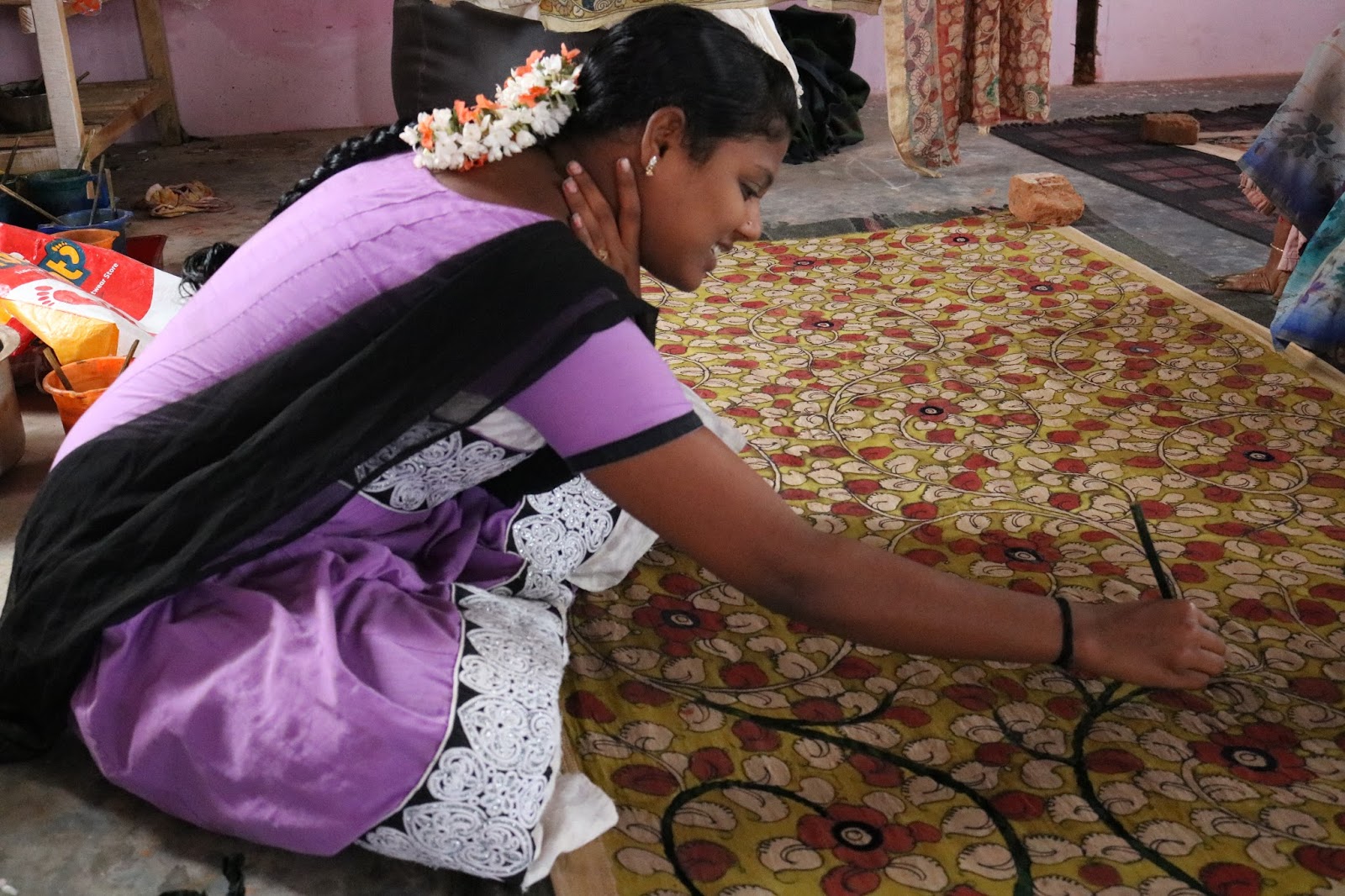
Next vision turned towards the Kalamkari handicraft work for which Srikalahasti is famous. I took one local traveler along with me in search of that work. First, we went to Bahadur peta Sahi where after a lot hard searching we reached a small house where few local craftswomen busy to draw the design on the cotton clothes. Kalamkari is an age-old tradition to do design on the subject of local folk and inspire from nature they do design about leaves and birds, and after designing they normally use vegetable dyes for coloring the designs on the clothes with the help of Pen.That's why it may be known as Kalamkari design.Under the patronage of the royal family, this handicrafts work reaches its peak but during social and industrial revolution gradually this Art lost its glory.After a long revival by many Artist and the initiative taken by local artist,the art got its patronage again at the fashion arena.


I did a little hard to visit other location in Kalahasti where I could explore more about the Kalamkari work and would shop few materials from them.As per the data that I carried with me I instructed to go to Bhanodaya Kalamkari, Sannidhi Street near Sukhabramasramam.Once I reached the doorstep of their workshop, it was amazing to watch the work directly. More than one artist did their work on the floor for designing and coloring on the clothes. After a little conversation with the owner of the workshop, i took interest to watch their work very closely.All the works on the materials were previously ordered by many designers as per the demand of the customers the kalamkari clothes were despatched to them. I did not get a single piece even after my request to her. One single piece required at least one week to design on it.They charged Rs 500 per one meter designing kalamkari clothes.


Again searching work continued where I would shop for myself. Time was less to spend on marketing. Still, i went to local market but failed to get what I expected to do for myself.Though Kalamkari work is originated there not much scope to get.a lump sum variety to procure for oneself.My experience in search of Kalamkari handicraft work gave me enough chance to learn a lot. Returned with a huge exposer with the public of a remote location of India where knowledge and Artwork have been blended with each other very sophisticatedly.